
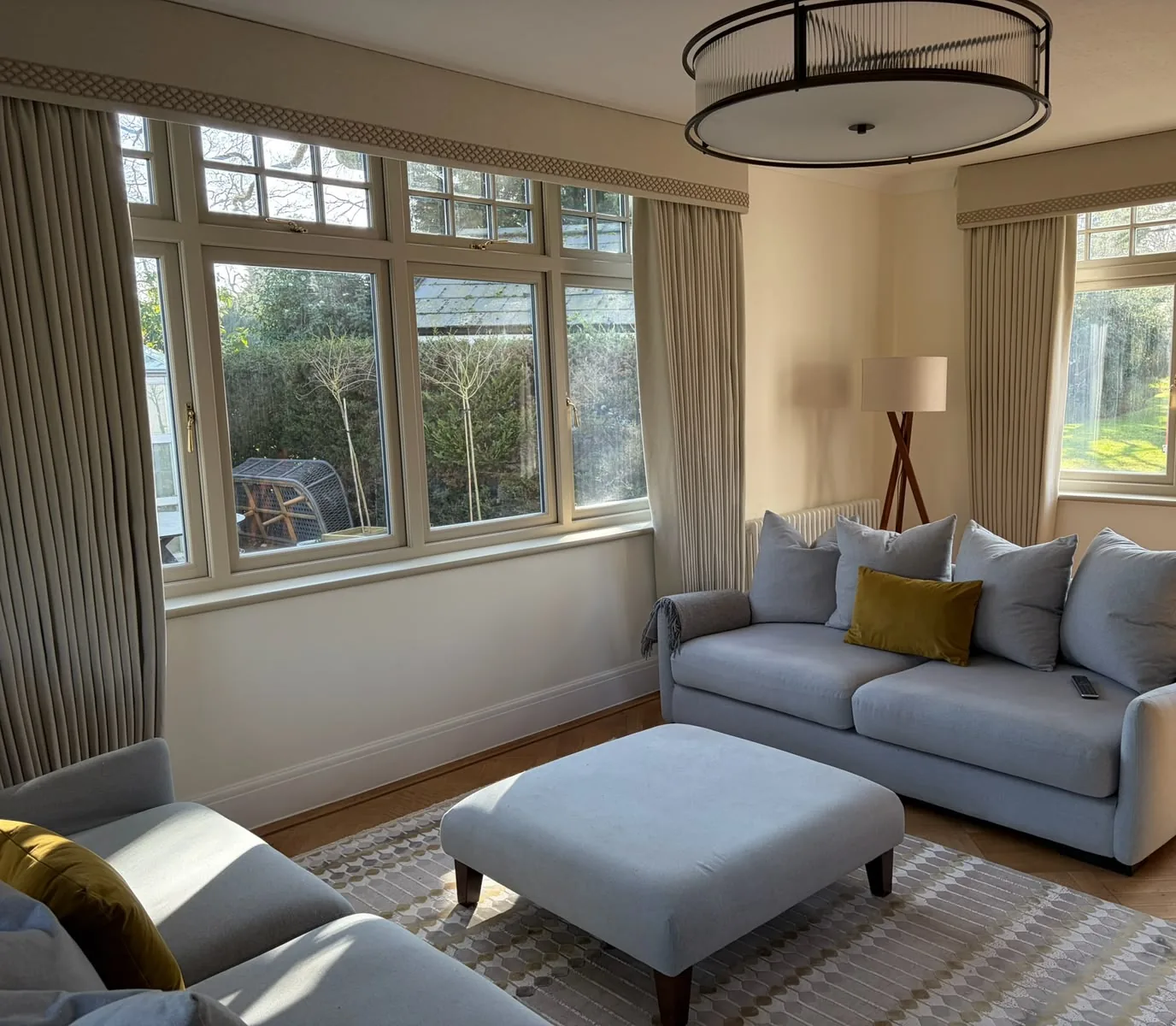
A pelmet is a fabric-covered or shaped box fixed above a window that hides the curtain track or pole and the top of the curtains. In everyday British use the word also covers softer, gathered tops, which are usually called valances. Either way, it finishes the top of a window.
What is a pelmet, and what does it do?
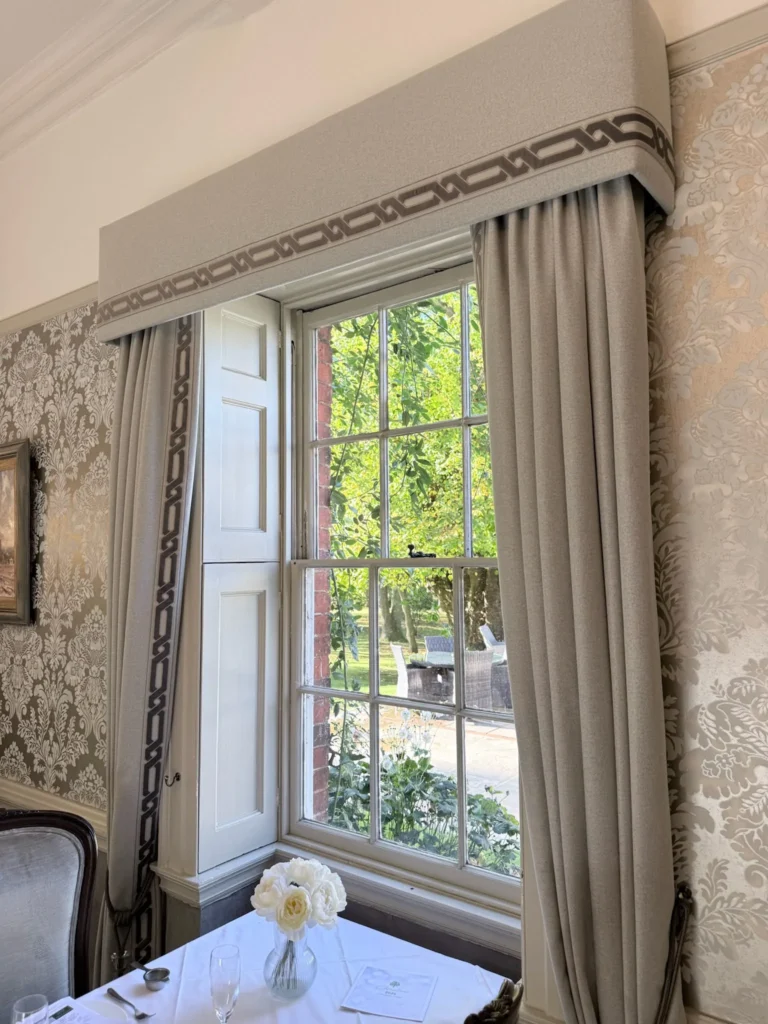
A pelmet sits across the top of the window, in front of the heading. Its first job is practical: it hides the track, the hooks and the tops of the curtains, so you see clean folds below rather than hardware.
Its second job is to shape the window. A pelmet gives a straight, scalloped or curved line above the curtains and ties the window into the rest of the room.
We make pelmets in our workroom, shaped, scalloped or covered in fabric, to sit over curtains or a Roman blind. Many are finished with a fringe or a contrast trim.
What is the difference between a pelmet and a valance?
The words overlap, and sellers use them differently. In British English “pelmet” is often used for both hard and soft tops. The more useful question to ask is whether the piece is hard or soft.
| Type | How it looks | How it is made |
|---|---|---|
| Pelmet (hard) | A clean, structured outline: straight, shaped or scalloped | A fixed shape covered in fabric, so the line stays crisp |
| Valance (soft) | A softer, gathered or pleated fall of fabric | Fabric that hangs and moves, rather than a fixed shape |
| Cornice | A solid, often wooden top, sometimes with moulding | A rigid fixture, usually painted or covered |
If you are not sure which a supplier means, ask for a sketch or a photograph. The name alone will not tell you.
What shapes can a pelmet take?
The outline is where a pelmet gets its character. Common choices are:
- Straight: a plain box with a clean lower edge, which suits modern rooms and simple windows.
- Shaped: a gentle curve or a stepped line that follows the room’s style.
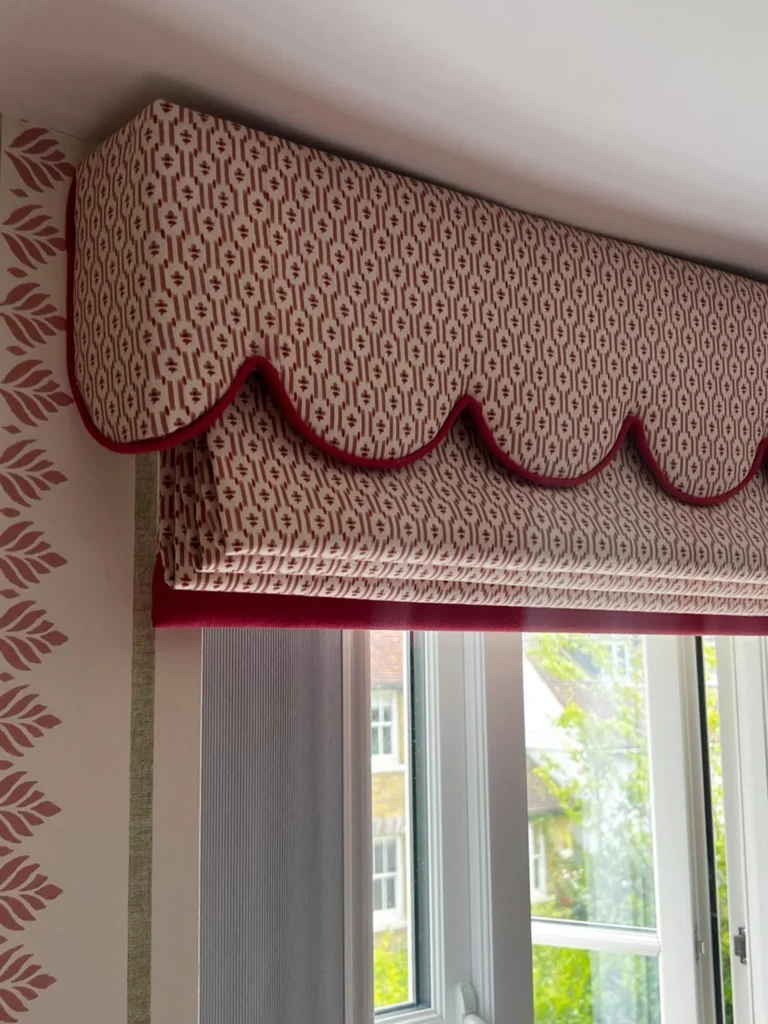
- Scalloped: a row of rounded curves along the lower edge, a softer and more traditional look.
You can see two of these side by side in our shaped and scalloped pelmets project.
Where does a pelmet work well?
A pelmet suits several kinds of window and room:
- Period homes: a pelmet suits sash windows and panelled rooms, where a finished top feels in keeping.
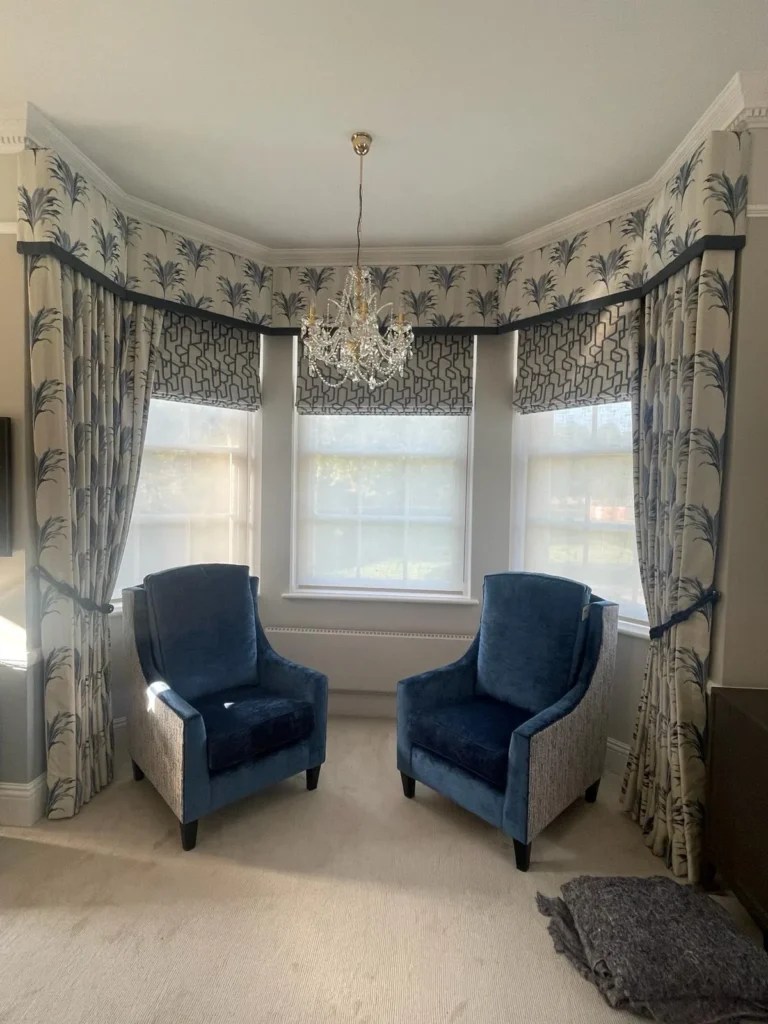
- Bay windows: one pelmet can run around the bay and join the windows into one picture. We look at this in our guide to curtains for bay windows.
- Ceilings with beams or awkward lines: a covered pelmet can sit neatly under a beam, as in our mustard wave curtains under oak beams.
- Over a Roman blind: a pelmet can finish a blind and hide its headrail.
A pelmet is a choice about style. If you prefer a simpler top, a good heading may be enough, and our guide to curtain heading types shows the options.
How do you choose the fabric and trim?
There are two usual routes. A pelmet in the same fabric as the curtains looks calm and unified. One in a contrasting or coordinating fabric becomes a feature in its own right.
Trims are where a pelmet picks up detail. A braid, a fringe or a velvet edge defines the lower line and can echo something else in the room, such as a cushion. Keep to one trim at a time, so the pelmet frames the curtains rather than competing with them.
What should you plan before ordering a pelmet?
A pelmet sits in front of the curtains, so it needs room above and in front of the window. Think about these points:
- Whether the curtains and pelmet will be made together, so they fit as a pair.
- How far the curtains need to stack back, and whether the pelmet clears them.
- The height of the ceiling or cornice above the window.
- Whether a pole or a track is going behind it.
Measurements matter here, and our measuring guide is the place to start. For a pelmet, the usual route is to tell us about the room: we make each one to measure, so there is no price list. Email us rough dimensions and we will give you a guide price.
You can see a pelmet planned with curtains and Roman blinds in our fern-print bay window. If you would like a pelmet made for your own windows, see our made-to-measure curtains.